
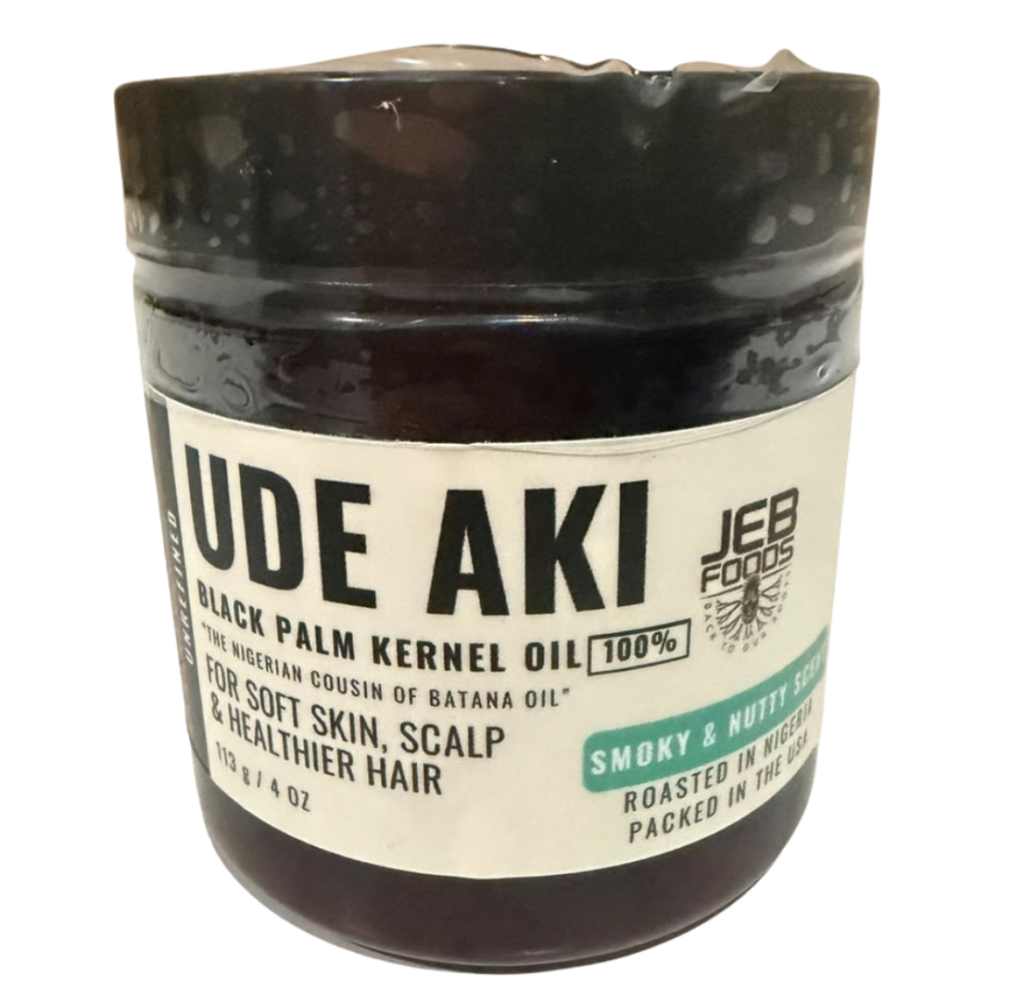
Batana oil is everywhere now, and so are the warnings about fake batana oil. Search for it and you will find jars that say “100% pure” on the front and something else on the back, and rules on social media about what real batana oil is supposed to look like. Some of those rules are wrong.
This guide shows you how to tell real batana oil from a blend before you buy, what colour and smell actually tell you, and how to check a jar of African batana oil is genuine.
First, the two kinds of batana oil
The oil palm family has exactly two species, and both give a kernel oil made the same way.
- Honduran batana oil comes from the kernel of the American oil palm, Elaeis oleifera, which grows from Honduras to northern Brazil. It is also called ojon oil, and it is traditionally made by the Miskito people of Honduras. On a cosmetic label it is listed as Elaeis Oleifera Kernel Oil.
- African batana oil is black palm kernel oil, from the kernel of the African oil palm, Elaeis guineensis. In Nigeria it is called Ude Aki. On a cosmetic label it is listed as Elaeis Guineensis (Palm) Kernel Oil.
The method is the same on both continents: the nuts are cracked, the kernels are cooked over a fire until the oil comes out, and the oil is sieved. One process, two continents. The species is the only real difference.
So “real” does not mean one continent is genuine and the other is fake. A real jar is one that contains what the label says, and nothing else.
For the full side by side, read Batana oil vs palm kernel oil: what is the difference?.
7 ways to tell real batana oil from fake
1. Turn the jar over and read the ingredients
This is the single most useful check. The front of a jar can say anything. The ingredient list has to be accurate.
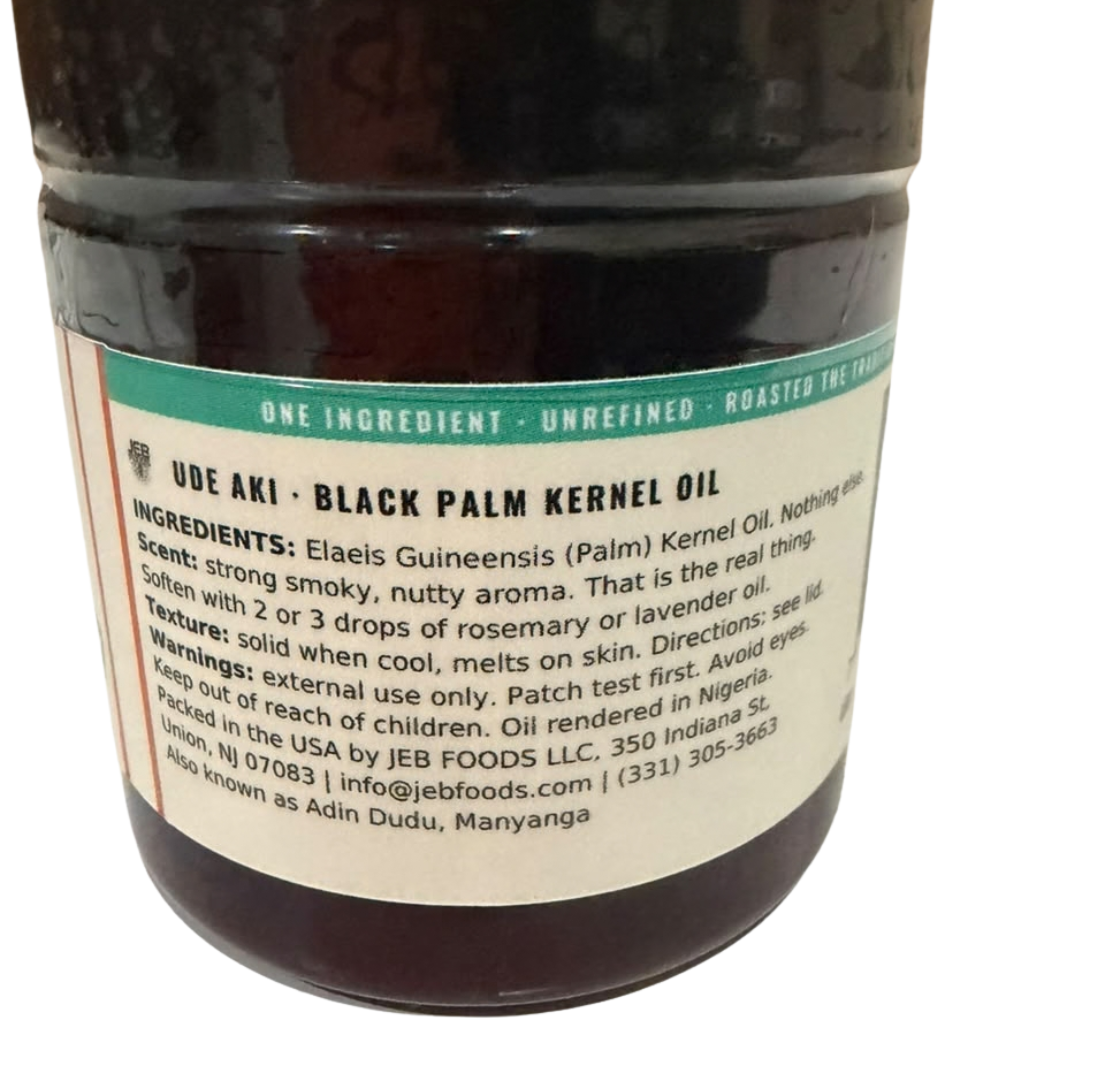
Pure batana oil has one ingredient. You should see Elaeis Oleifera Kernel Oil (Honduran batana) or Elaeis Guineensis (Palm) Kernel Oil (African batana) and nothing else.
If you see other oils, fragrance, “parfum”, preservatives or a long list, it is a blend. A blend may still be a fine product, but it is not pure batana oil.
2. “100% pure” on the front must match the back
“Pure batana oil”, “100% batana oil” and “raw batana oil” are words on a label, not proof. If the front says 100% pure and the back lists more than one ingredient, believe the back.
3. Do not judge by colour alone
A rule going around social media says real batana oil is dark and fake batana oil is “green, light brown or clear”. Be careful with that rule, because the same jar of genuine oil can look very different depending on how you look at it.
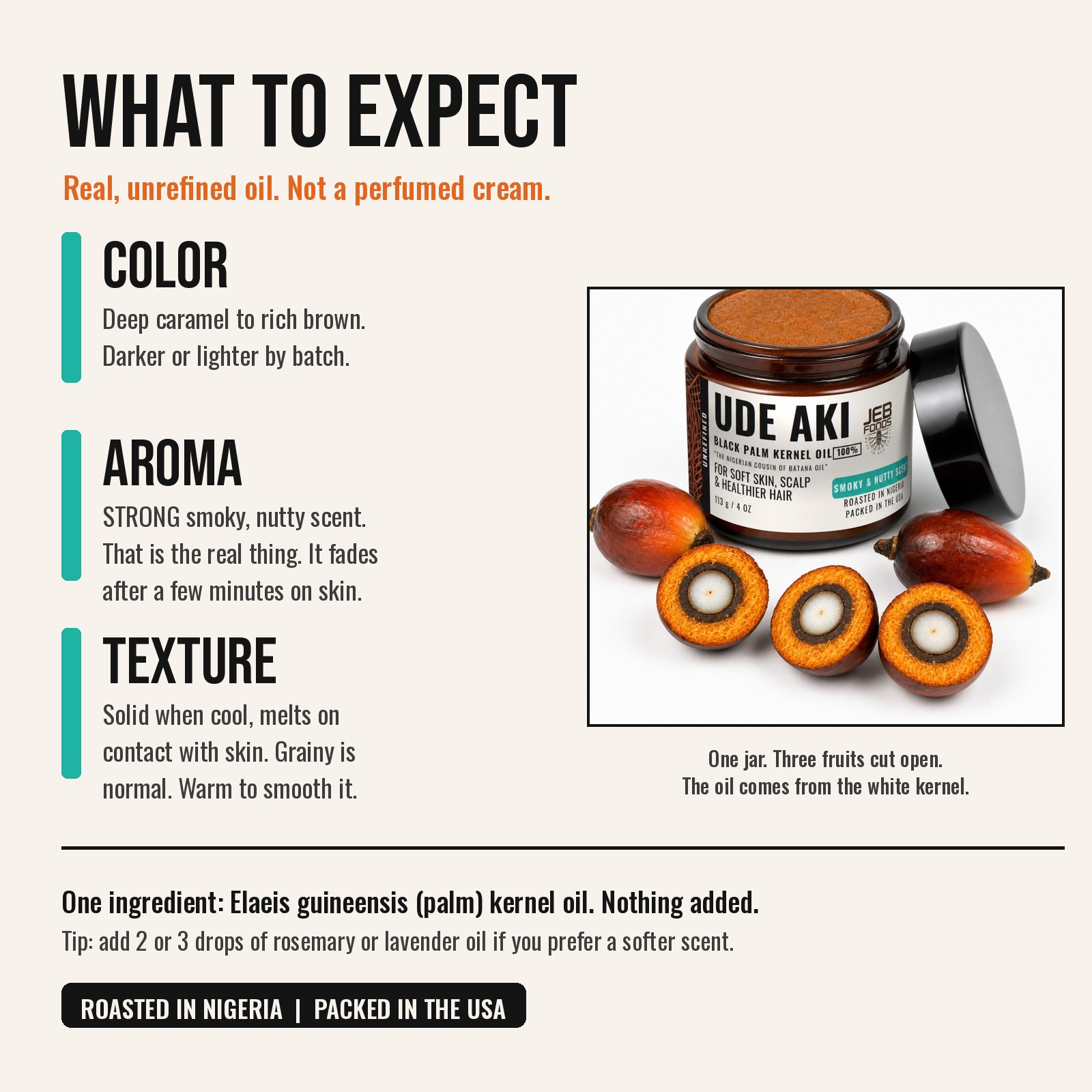
Look down into a full jar and you are looking through a lot of oil at once, so it looks very dark. Take a little out and rub it on your skin and it is a warm caramel orange. Solid or liquid, rubbed out thin it is the same colour. Batches run a shade lighter or darker because every batch is roasted over a live fire.
Use colour as a clue, not a verdict. A lighter smear on your hand is not proof of a fake.
4. Smell it
Oil made over a fire smells of the fire. Our African batana oil has a strong, smoky, nutty scent. That is the real thing. It fades after a few minutes on skin.
If a jar sold as pure batana oil smells of perfume, something has been added. Go back to check number 1.
5. Feel the texture
Our African batana oil is solid when cool and melts on contact with skin. A grainy surface is normal. Warm it to smooth it.
Solid or liquid, both are normal. Whatever the weather did in transit decides which one lands on your doorstep. If it arrives solid, warm it in your hands for a few seconds.
6. Know who made it
A real product tells you who made it and how to reach them. Look for:
- A company name and a physical address on the label
- A phone number or email you can use if you have a question or a reaction
- Where the oil comes from and where it was packed
- A batch or LOT number
If a jar has none of these, you have no one to ask.
7. Check whether the jar can be verified
The strongest proof is a check you can do yourself, on the jar in your hand, before you open it. Look for a seller that offers one. Here is how ours works.
How we make sure your Ude Aki is the real thing
Ude Aki is our African batana oil: black palm kernel oil from Nigeria, cracked, roasted over firewood and sieved. Nothing added. This is everything we do so you can trust the jar.
Every jar has its own code
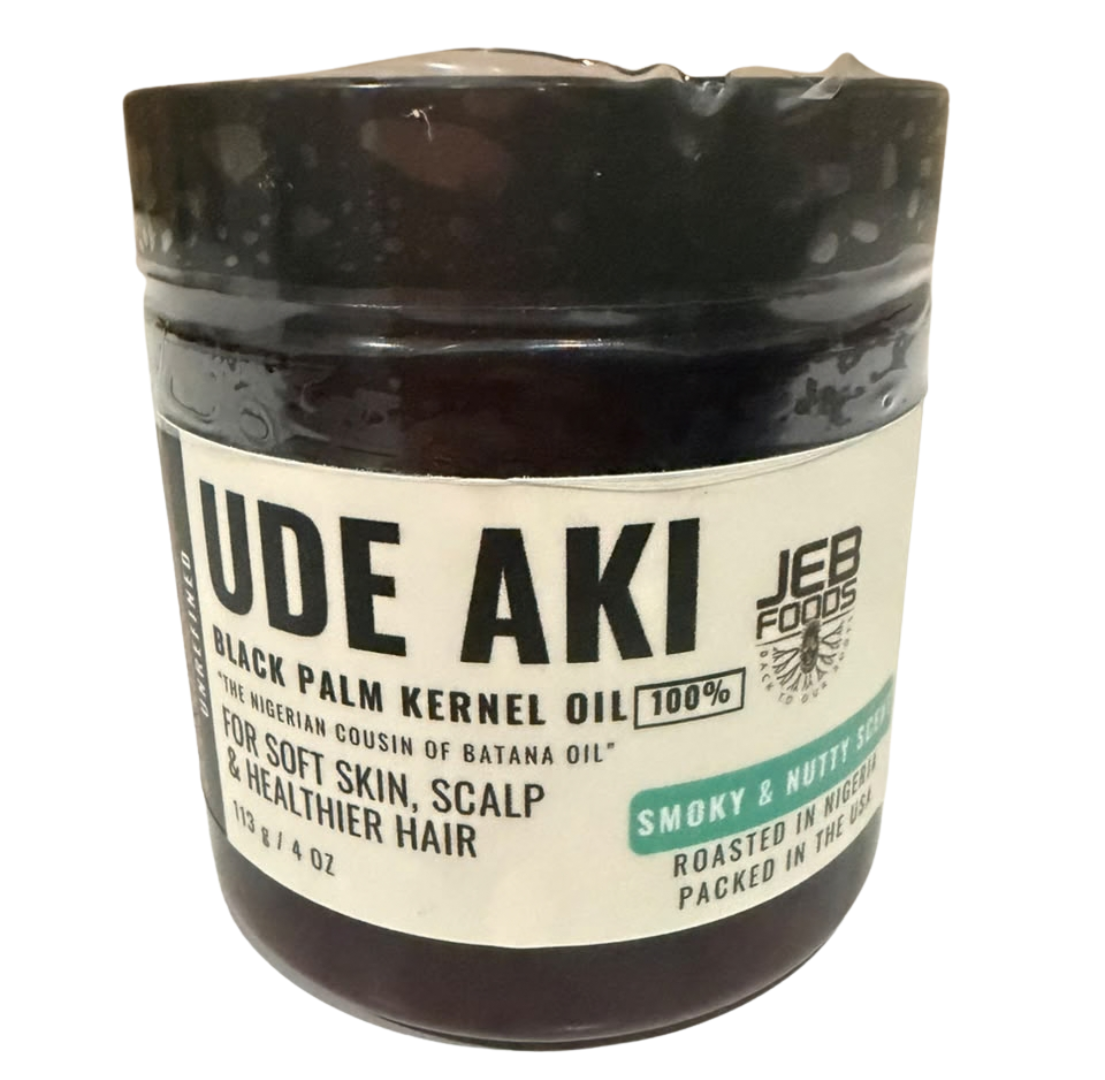
Every new jar of Ude Aki carries its own code. Scan the QR on the lid, or type the code printed under it, at jebfoods.com/real. Each code belongs to one jar, and the page tells you if that code has been checked before. So a copied code shows up.
The genuine LOT on sale now is printed on the lid, under the code, and the page lists it. When a new batch is jarred, it is added to that list.
If you bought your jar before 28 September 2026 and your lid has the older sticker that reads LOT UA-2026-001, that sticker was the same on every jar, so it no longer proves a jar is real. Email a photo of the lid to info@jebfoods.com and we will confirm it within one business day.
A written guarantee
Four things we promise, in writing:
- One ingredient. Black palm kernel oil and nothing else. No carrier oils, no fragrance, no fillers.
- Roasted in Nigeria, on a live firewood fire, by hand.
- Filled to the line and sealed. If the seal is already broken when it reaches you, do not use it.
- No press, no solvents, no bleaching. The heat draws the oil out, and it drains through a sieve.
If your jar is not everything on this list, send it back. We refund you in full, including what the return postage cost you.
One ingredient, on the label
The back of every jar lists one ingredient: Elaeis Guineensis (Palm) Kernel Oil. It carries our US address, phone number and email, so you always know who to contact.
Tested by a third party
Our oil is third party microbial tested. Certificate on request.
Made in Nigeria, packed in the USA
The oil is rendered in Nigeria and packed in the USA by JEB FOODS LLC in Union, New Jersey. JEB FOODS is a registered US trademark.
Honduran batana oil or African batana oil: which should you buy?
Here is the honest part. Honduran batana oil and African batana oil are made the same way, from the same palm family. For your hair they do the same job: they moisturize, soften, seal in moisture and are used for strong hair. Same family, different home, same job.
And African batana oil is not only a hair oil. In West Africa, Ude Aki is used head to toe, on skin, scalp and hair. It moisturizes and softens skin, melts on contact and leaves a glow.
So if they do the same job, why choose the African one? Because when two oils are this close, the things you can check are what decide it.
1. You can check every jar yourself
Every jar of Ude Aki has its own code on the lid, checked at jebfoods.com/real. The page even tells you if that code has been checked before. You do not have to take anyone’s word for it.
2. A written guarantee, with a full refund
One ingredient. Roasted in Nigeria on a live firewood fire, by hand. Filled to the line and sealed. No press, no solvents, no bleaching. If your jar is not all of that, we refund you in full, including the return postage.
3. We make it ourselves
The batch on sale now was made by our own crew in Nigeria: kernels cracked, roasted over firewood and sieved. It is packed in the USA by JEB FOODS in Union, New Jersey, with our address, phone number and email on every jar.
4. One ingredient, third party tested
Elaeis Guineensis (Palm) Kernel Oil, nothing else. Third party microbial tested, certificate on request.
5. Thousands of years of practice
The oil palm is indigenous to West Africa, and West Africans have been cracking these kernels for about 5,000 years. Nigeria sits in the middle of the palm’s home range. Ude Aki is made the way it has always been made there.
6. Part of the profit goes back
Part of the profit funds our nonprofit organization, Save All Africa Kids (saak.org).
Same job, and a jar you can check. That is why we make Ude Aki black palm kernel oil. For how to use it on hair and skin, read How to use black palm kernel oil on hair, scalp and skin.
Questions people ask
How do I tell if my batana oil is real? Read the ingredient list first. Pure batana oil has one ingredient. Then check who made it, and whether the jar has a code or LOT number you can verify.
What colour is real batana oil? It depends on how you look at it. In a full jar it looks very dark. Rubbed thin on skin, our African batana oil is a warm caramel orange. Do not rely on colour alone.
What does real batana oil smell like? Oil made over a fire smells smoky and roasted. Ours has a strong, smoky, nutty scent that fades after a few minutes on skin. A perfume smell means something was added.
What is the difference between Honduran and African batana oil? The species. African batana oil comes from the African oil palm, Elaeis guineensis. Honduran batana oil comes from the American oil palm, Elaeis oleifera. Same process, same palm family. Either one is real when the label lists one ingredient and nothing else. Read African batana oil: what it is and what it is really called.
Does African batana oil do the same for hair as Honduran batana oil? Yes. They are made the same way from the same palm family and do the same job: moisturize, soften, seal in moisture and strong hair. Ude Aki is also used on skin across West Africa.
Is Ude Aki pure? Yes. One ingredient: Elaeis Guineensis (Palm) Kernel Oil. Nothing added.
Why is my jar solid when I expected oil? Solid or liquid, both are normal. If it arrives solid, warm it in your hands for a few seconds.
Read next: Ude Aki in English: names, uses and how it is made.