

Search for batana oil and you will run into palm kernel oil within about two clicks. Some pages say they are the same thing. Some say they are completely different. Both answers are wrong, and the confusion is costing people money.
Here is the plain version.
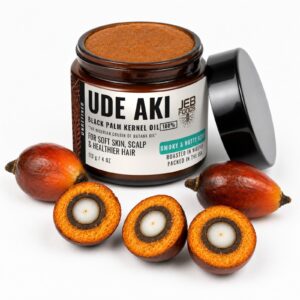
Both oils come from the oil palm genus Elaeis, which has two species.
The short answer
Honduran batana oil is a palm kernel oil. So is African batana oil, Nigerian black palm kernel oil. They are made by the same process. The difference is the species of palm.
Both come from the kernel inside a palm nut. Both are made by cracking the nut and cooking the kernel over fire. Both come out caramel to rich brown, solid when cool, oil in the hand. One tree grows in Honduras, the other in West Africa. Same family, different home, same job.
They are closer than almost anything you will read online admits.
Is batana oil a palm kernel oil?
Yes. The cosmetic ingredient name for Honduran batana oil is Elaeis Oleifera Kernel Oil. For African batana oil it is Elaeis Guineensis (Palm) Kernel Oil. That is the name that appears on a properly labelled bottle, and the word in the middle is kernel.
This is where most of the confusion starts. People see the fruit of the palm being boiled in videos of batana being made and assume the oil comes from the fruit. It does not. Boiling the fruit is how you get to the nut. The pulp is pounded off and thrown away. The nuts are washed, dried, cracked open with stones, and the kernels inside are then cooked over a fire to release the oil.
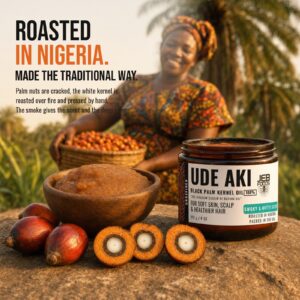
Nigerian black palm kernel oil is made the same way. The kernels are cracked out of the palm nut and roasted on a live firewood fire until the heat itself drives the oil out. It drains through a sieve into the pot below. No press, no solvents, no bleaching.
Set the two side by side and the steps are the same: the nut is cracked, the kernel is roasted over a fire, and the oil is sieved. One process, two continents.
Where each one comes from
Honduran batana oil comes from Elaeis oleifera, the American oil palm, native to Central and South America and associated above all with Honduras. It is traditionally made by the Miskito people of Honduras. You will also see it sold as ojon oil.
African batana oil, black palm kernel oil, comes from Elaeis guineensis, the African oil palm. It is native to West Africa, and Nigeria sits right in the middle of its range. In Igbo the oil is called ude aki. Nigerian households have been making it and putting it on hair, scalp and skin for generations.
What is comparable to batana oil?
This is the question people actually type, so here is a straight answer.
The closest thing to Honduran batana oil is palm kernel oil from the African palm, because it is the same part of the same kind of tree, prepared the same way. It is often sold as African batana oil. Not coconut oil, which comes from a different plant entirely. Not red palm oil, which is pressed from the fruit rather than the kernel and is a different oil with a different job. See palm kernel oil vs palm oil.
If what you like about batana is that it is a single ingredient, unrefined, fire made kernel oil from a palm, then African black palm kernel oil is the nearest relative there is.
The list of real differences is shorter than you would expect:
- The species. This is the one that matters. Elaeis oleifera in Honduras, Elaeis guineensis in West Africa
- Where it is made, and by whom. Miskito communities in La Mosquitia, or Nigerian households and small producers
- Supply and price. Batana is genuinely rare. The palm grows in a small part of the world and the work is done by hand, which is why it costs what it costs
What does not differ much is the oil itself. Both run from caramel to a rich brown and shift a little from batch to batch, because every batch is roasted over a live fire.
The same jar can look very different depending on how you look at it. Look down into a full jar and you are looking through a lot of oil at once, so it looks very dark. Take a little out and rub it on your skin and it is a warm caramel orange. Solid or liquid, rubbed out thin it is the same colour. Both are solid when cool and turn to oil the moment they touch warm skin. Both carry the nutty smell of the fire they were made over. Set a jar of each on a table and you would struggle to say which is which without being told.
Anyone selling you one of them on the promise that it looks or feels completely different from the other is describing a difference that is not there.
Side by side
| Honduran batana oil | African batana oil (black palm kernel oil) | |
|---|---|---|
| Plant | Elaeis oleifera, the American oil palm | Elaeis guineensis, the African oil palm |
| Ingredient name | Elaeis Oleifera Kernel Oil | Elaeis Guineensis (Palm) Kernel Oil |
| Home | Honduras, Central America | Nigeria and West Africa |
| Part used | The kernel, the same on both | |
| Method | Nut cracked, kernel roasted over a fire, oil sieved. One process, two continents | |
| Colour | Caramel to rich brown, varies by batch | |
| Texture | Solid when cool, melts on contact with skin | |
| Scent | Nutty, with the smell of the fire it was made over | |
| Other names | Ojon oil | Ude Aki, Adin Dudu, Manyanga |
Is palm kernel oil good for hair growth?
We are not going to tell you it grows hair, and we would treat anybody who does with suspicion.
The same applies to batana, and you do not have to take our word for it. Formula Botanica, a cosmetic formulation school with no product to sell you, looked at the evidence and concluded there are no clinical studies showing batana oil causes hair growth, and answered the direct question with a flat no.
What a heavy kernel oil can do is coat the hair shaft, hold moisture in, and reduce the breakage that makes hair look like it is not growing. Less breakage and more length retained is not the same thing as faster growth, but it is what most people are actually after.
If a seller tells you their oil regrows a bald patch, that is a claim they cannot support, whichever palm it came from.
What are the cons of batana oil?
Three worth knowing before you spend.
Price. Honduran batana oil is a rare oil made by hand in a small region. That is a fair reason for it to cost what it costs, but it does cost.
Blends sold as pure. Read the ingredients, not the front of the bottle. If the label lists sunflower, coconut, almond or any other oil alongside the batana, you are buying a blend. Some are honest about it. Many are not.
Weight. It is a heavy oil. On fine hair it can flatten rather than help. That is true of black palm kernel oil too. Both are better used sparingly, warmed in the hands, or as a treatment you wash out.
How people actually use them
The routines look almost identical.
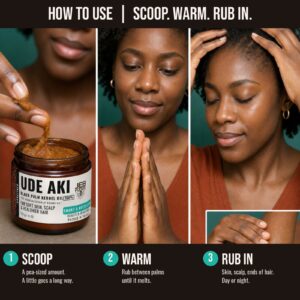
That is not a coincidence. They behave the same in the hand. Both are warmed between the palms first, because both firm up when cool. Both are worked into the scalp and through the lengths. Both are used on skin, and both are used on beards.
The common Nigerian habit with black palm kernel oil is either to work a small amount in and leave it, or to use it as a pre wash treatment for about thirty minutes before shampooing. We wrote a longer guide on that here: how to use black palm kernel oil on hair, scalp and skin.
What we are not going to tell you
Most of what is written about batana oil online promises hair growth. We are not going to repeat that promise, about batana oil or about ours.
We sell a single ingredient oil. We will tell you what it is, where it came from, and how people use it. What it does for your hair is between you and your hair.
Questions people ask
Is Elaeis oleifera kernel oil the same as batana oil?
Yes. That is the ingredient name for Honduran batana oil. African batana oil is listed as Elaeis Guineensis (Palm) Kernel Oil. If a bottle says batana oil but the ingredient list says neither, ask why.
Is batana oil the same as palm oil?
No. Red palm oil is pressed from the fruit. Batana oil comes from the kernel. Different part of the plant, different oil.
Is black palm kernel oil the African version of batana oil?
Yes. It is African batana oil: the same part of the plant, made the same way, from the African species instead of the American one. It is not a copy and it is not a substitute made to imitate anything.
Which one should I buy?
For your hair, Honduran and African batana oil do the same job: they moisturize, soften, seal in moisture and are used for strong hair. African batana oil is also used head to toe in West Africa, on skin as well as hair.
So choose on what you can check.
Every jar of Ude Aki has its own code on the lid that you can check at jebfoods.com/real. It comes with a written guarantee and a full refund, including the return postage. The batch on sale now was made by our own crew in Nigeria. It is one ingredient and third party microbial tested. To check any jar before you buy, read real batana oil vs fake: 7 ways to tell. And part of the profit funds our nonprofit organization, Save All Africa Kids (saak.org).
Is batana oil also called ojon oil?
Yes. Batana oil and ojon oil are the same oil, from the American oil palm, Elaeis oleifera. Its cosmetic ingredient name is Elaeis Oleifera Kernel Oil.
What is the ingredient name for black palm kernel oil?
Elaeis Guineensis (Palm) Kernel Oil, from the African oil palm. Both are kernel oils, made from the seed inside the palm nut. Same family, different home, same job.
If you want to try the African one
We make Ude Aki Black Palm Kernel Oil, 4 oz, roasted on firewood in Nigeria and packed in New Jersey. One ingredient: Elaeis guineensis kernel oil. No carrier oils, no fragrance, no fillers.
If you use it regularly there is a subscribe and save option, and the rest of what we make for hair and skin is in African Beauty.