

What is bitter kola? If you have seen it on a market table or in a Nigerian kitchen and wondered what it actually is, this page answers that. No health talk, no promises. Just what the nut is, where it comes from, and what people do with it.
What is bitter kola
Bitter kola is the seed of Garcinia kola, a tree that grows across the rainforest belt of West and Central Africa. The seeds sit inside a fruit about the size of a small apple. When the fruit is opened the seeds are cleaned and dried.
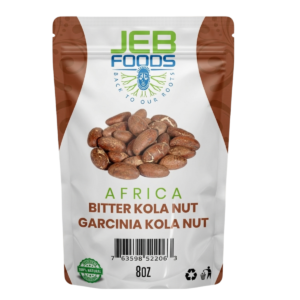
The taste is the reason for the name. It is genuinely bitter, sharp at first, and then a slow sweetness arrives behind it. People who grew up with it describe that turn as the whole point.
It is not the same as kola nut
This trips up almost everybody. There are two different nuts and English lumps them together.
| Bitter kola | Kola nut | |
|---|---|---|
| Plant | Garcinia kola | Cola nitida or Cola acuminata |
| Taste | Bitter, then sweet | Bitter, then sweet, with caffeine |
| Look | Small, smooth, brown, one piece | Larger, splits into lobes, often pink or red |
| Also called | Petit cola, false kola | Obi, obi abata, gworo |
Different trees, different families. If a recipe calls for one, the other will not do.
What it is called
- Igbo: aku ilu, ugolo
- Yoruba: orogbo
- Hausa: miji goro
- French speaking West Africa: petit cola
- Scientific: Garcinia kola
You will also see it sold as bitter kola nut, African bitter kola and garcinia kola. They are all the same thing. Read bitter kola in Yoruba, Igbo, Hausa and French for each name.
What it is used for
Hospitality
In many Nigerian homes bitter kola is part of how a guest is received, alongside kola nut. It is offered whole: each guest takes one, peels it and eats it. Breaking and sharing is how kola nut is served, not bitter kola. That is a social ritual, not a recipe.
Cooking
Ground bitter kola turns up in soups and stews where a bitter note is wanted, in the same way you would reach for bitter leaf. It is used in pepper soup in some households. It is also used to flavour drinks, and in baking where a sharp edge is welcome.
Chewing
Plenty of people simply chew the whole nut, slowly, the way you would a strong coffee bean.
Whole nuts or powder
Whole nuts keep longer and are what you want if you are chewing them or offering them to guests. They are hard, and you will want a good knife or a small grater if you plan to cook with them.
Powder is what you want for cooking. The grinding is already done, it dissolves into liquid, and you can measure it. The trade off is that ground spice loses its edge faster than whole, so buy the size you will use.
What we are not going to say
Search for bitter kola and you will find pages making medical claims about it. We used to have some of that language on this site and we took it down.
Jeb Foods sells bitter kola as food. We will tell you what it is, what it tastes like and how it is used in Nigerian kitchens. We are not going to tell you what it will do for your body, and we would be careful with anyone who does.
Questions people ask
What does bitter kola taste like?
Sharply bitter on the first bite, with a sweetness that comes up behind it and stays. Some people compare the aftertaste to liquorice.
Is bitter kola the same as garcinia kola?
Yes. Garcinia kola is the botanical name for the same plant.
Is bitter kola the same as petit cola?
Yes. Petit cola is what it is called in French speaking parts of West Africa.
How do you store it?
Whole nuts: somewhere cool, dry and dark, in a closed container. Powder: sealed, away from heat and light, and use it while it is still fragrant.
How much do you use in cooking?
Less than you would think. It is assertive. Start with half a teaspoon of powder in a pot and taste before you add more.
The bitter kola plant
Bitter kola, sometimes spelled bitter cola, is the seed of Garcinia kola, a flowering plant in the mangosteen family, Clusiaceae. The tree grows wild in the moist lowland forests of West and Central Africa. It is found in many African countries, including Nigeria, Ghana, Sierra Leone, Benin, Cameroon, Liberia and Senegal.
It is a slow tree to grow, and its seeds are hard to germinate. That is one reason most bitter kola still comes from wild trees rather than farms. The species is listed as vulnerable by the IUCN. Read how long bitter kola takes to grow.
It is not the kola tree. The true kola nut comes from Cola acuminata, which belongs to a different plant family altogether. See bitter kola vs kola nut.
Bitter kola seeds and their bitter taste
The seed has a thin brown skin. The bitter taste comes first, and a mild sweetness follows behind it. That bitterness is the reason for the name in English, and it is why a little goes a long way in food.
Bitter kola in traditional medicine
The seeds, bark and fruit have a long place in West African traditional medicine, and it is still used as a chewing stick. Scientists have studied the seed in laboratories, including a group of compounds called biflavonoids, such as kolaflavanone.
That history is real. It is not proof. Laboratory and animal studies are not the same as tests in people, and a 2023 review of the research says human clinical trials are still needed. Read the review.
What about bitter kola health benefits?
You will find long lists of health benefits online, for wellness, diet, weight loss and inflammation. We make no health claims. If weight loss is your question, read does bitter kola cause weight loss for what the research does and does not show. For any health question, ask your doctor.
Bitter kola products you will find in African markets
In African markets and African grocery stores, bitter kola is usually sold as whole seeds, loose or in bags. Ground bitter kola powder is the other common product. Jeb Foods sells both: whole bitter kola nuts and bitter kola powder.
Where to buy it
Jeb Foods sells both formats:
- Nigeria Bitter Kola Nut, whole, 0.5 lb
- Bitter Kola Nut Powder, 4 oz, one ingredient, ground
Looking for it in a store near you? See where to buy bitter kola in the USA.
If you want to cook with it, start here: bitter kola uses, and how to cook with the powder.
New to bitter kola? Read how to eat bitter kola: peel it, then eat it bite by bite.